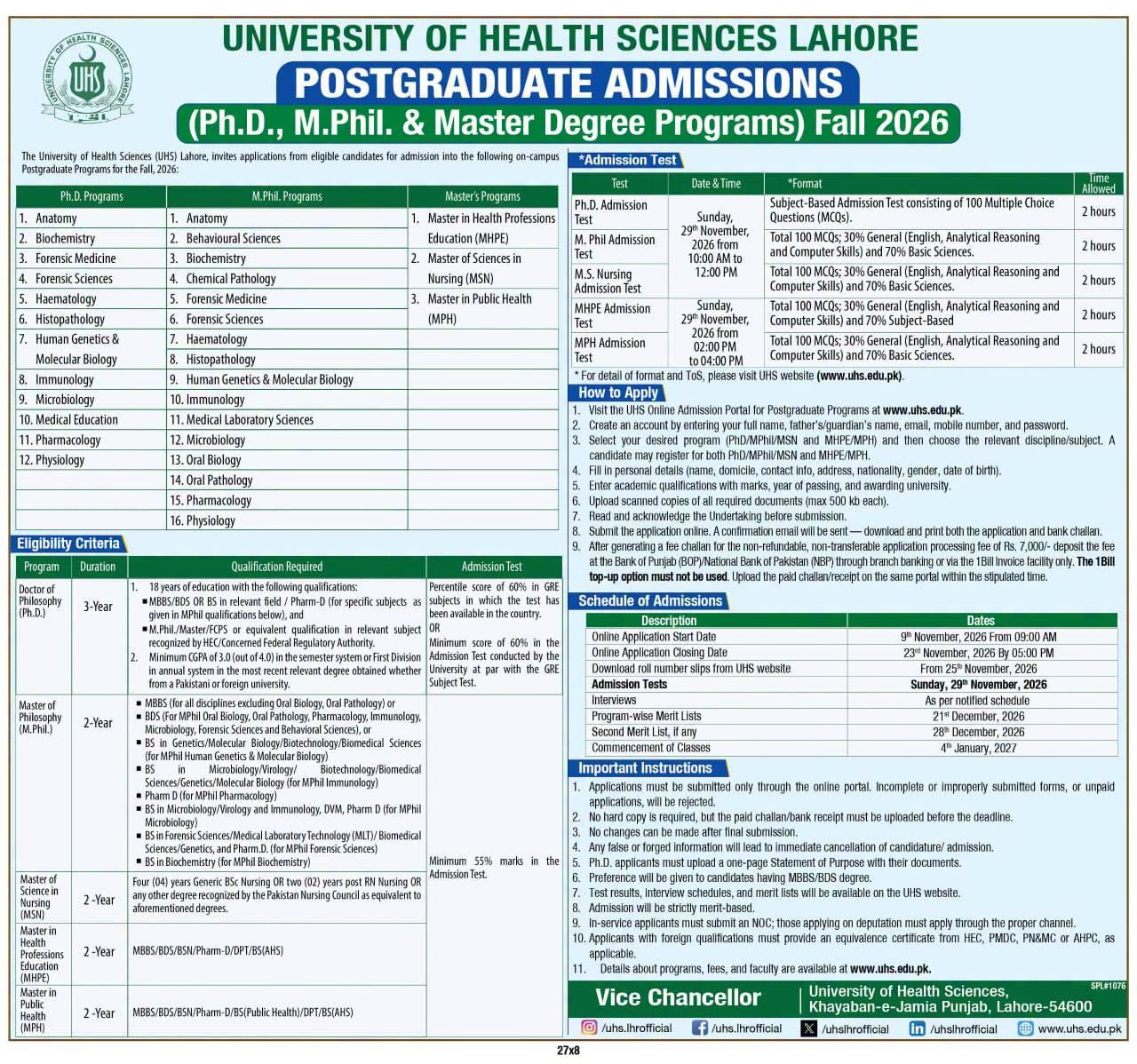
UHS Postgraduate Admissions Fall 2026: PhD, MPhil and Master's — Apply by 23 November

Last date to apply: Monday, 23 November 2026. Online applications open Monday, 9 November 2026, through the UHS admissions portal.
Programmes: 31 postgraduate programmes for Fall 2026 — 12 PhD disciplines, 16 MPhil disciplines and 3 Master's programmes (MHPE, MSN and MPH) at the University of Health Sciences (UHS) Lahore.
New eligibility rule: Postgraduate admission is no longer limited to MBBS and BDS graduates. Allied Health Sciences, Pharmacy and other relevant graduates are now eligible for SPECIFIED MPhil and PhD programmes, subject to each programme's own eligibility criteria.
Admission test: All postgraduate admission tests are held on Sunday, 29 November 2026. Roll number slips are downloadable from Wednesday, 25 November 2026.
Merit lists: First programme-wise merit lists on Monday, 21 December 2026; second merit lists (if required) on Monday, 28 December 2026. Classes commence Monday, 4 January 2027.
Apply: Online only through the UHS admissions portal — see also the UHS website and the announcement in The News. Application fee: Rs 7,000, non-refundable and non-transferable — pay at a Bank of Punjab or National Bank branch, or via the 1Bill invoice facility only (do NOT use the 1Bill top-up option), then upload the paid challan on the portal. The test pattern and seat numbers have not been published — confirm them on the portal.
UPDATE — Monday, 9 November 2026: the official UHS advertisement (Postgraduate Admissions Fall 2026, on uhs.edu.pk) publishes the application processing fee: Rs 7,000, non-refundable and non-transferable. Generate the fee challan on the portal, deposit it at a Bank of Punjab (BOP) or National Bank of Pakistan (NBP) branch or via the 1Bill invoice facility only — the 1Bill top-up option must not be used — and upload the paid challan/receipt on the same portal within the stipulated time. The portal opens at 9:00 AM on Monday, 9 November 2026 and closes at 5:00 PM on Monday, 23 November 2026.
The University of Health Sciences (UHS) Lahore has opened admissions to its Fall 2026 postgraduate programmes, and the last date to apply is Monday, 23 November 2026. The admission covers 31 programmes — 12 PhD disciplines, 16 MPhil disciplines and 3 Master's programmes — and online applications open on Monday, 9 November 2026, through the UHS admissions portal. All postgraduate admission tests are held on a single day, Sunday, 29 November 2026, with roll number slips downloadable from Wednesday, 25 November 2026. The first programme-wise merit lists are displayed on Monday, 21 December 2026, second merit lists — if required — on Monday, 28 December 2026, and classes commence on Monday, 4 January 2027. The announcement was made on 5 November 2026 and reported the same day by The News and by MedicalNews.pk.
The headline in this admission is not the number of programmes. It is the rule change. The university's Syndicate has approved a change under which postgraduate admission at UHS is no longer limited to MBBS and BDS graduates. Graduates with relevant qualifications in Allied Health Sciences, Pharmacy and other disciplines are now eligible for specified MPhil and PhD programmes, subject to the eligibility criteria of each programme. That single change opens the door to the largest group of health graduates in Punjab who were previously locked out of UHS postgraduate degrees: the allied-health technologists, the medical laboratory scientists, the pharmacists, the physiotherapists and the other health-science graduates whose degrees were never MBBS or BDS. For them, this is the first Fall admission in which UHS postgraduate study is genuinely on the table — and the window is only fourteen days, from 9 November to 23 November.
Every fact in this post comes from the announcement reported on 5 November 2026 in The News and on MedicalNews.pk, with the UHS website and the UHS admissions portal as the official sources for the application itself. Where the sources are silent — and they are silent on several things applicants will want to know — this post says so instead of inventing figures. The application processing fee is now published — Rs 7,000 (see the update at the top of this post). The merit and selection formula . The test paper pattern and marks have not been published. Per-programme seat numbers and tuition fees have not been published. The fee now appears in this post, from the official UHS advertisement; the formula and seat counts still do not, and no applicant should trust a formula or a seat count quoted on social media or by an academy. The portal is the only source that can confirm them.
What has opened, and why it matters
UHS Lahore announced the Fall 2026 postgraduate admission on 5 November 2026, and the admission is a single centralised process for 31 programmes across three levels: PhD, MPhil and Master's. It is the university's own postgraduate admission — the degrees are awarded by UHS itself, at its Lahore campus and its constituent institutions — and it is different from every other UHS admission running this season. It is not the UHS Punjab private MBBS/BDS admission, which is an undergraduate admission for medical and dental colleges. It is not the UHS BS Allied Health Sciences admission, whose Fall 2026 calendar runs on its own schedule. And it is not the PGET, the postgraduate entry test held on 25 October 2026 for Level III clinical induction — that was a different admission, for a different purpose, and it has already taken place. The Fall 2026 postgraduate admission is a separate event, with its own programmes, its own application window and its own test day.
The timing matters because the window is short and the test is fixed. Applications open on Monday, 9 November 2026, and close on Monday, 23 November 2026 — fourteen days, with no late window announced. Roll number slips are downloadable from Wednesday, 25 November 2026, which gives candidates two days to check their test centre and their details before the test. All postgraduate admission tests are held on Sunday, 29 November 2026. Interviews follow a schedule the university will notify — no interview dates have been published yet. The first programme-wise merit lists are displayed on Monday, 21 December 2026, the second merit lists, if required, on Monday, 28 December 2026, and classes commence on Monday, 4 January 2027. From the last date to the first day of class is six weeks, and from the test to the first merit list is three weeks. There is no slack in that schedule, and no second chance in this session: a candidate who misses 23 November waits for the next admission cycle.
The policy change matters more than the schedule, because it changes who can apply. Until this round, UHS postgraduate admission was limited to MBBS and BDS graduates. That restriction shaped the entire postgraduate landscape in Punjab: a medical laboratory technologist with a four-year BS degree, a pharmacist with a Pharm-D, a physiotherapist with a DPT, a speech therapist, a nutritionist — none of them could enter a UHS MPhil or PhD in their own discipline, because the door was open only to doctors and dentists. The Syndicate's approval changes that. Allied Health Sciences graduates, Pharmacy graduates and graduates of other relevant disciplines are now eligible for specified MPhil and PhD programmes. The word "specified" does the heavy lifting, and it must be read carefully: it does not mean every graduate is eligible for every programme. Admission remains subject to the relevant qualification requirements for each discipline. A pharmacy graduate is eligible for the programmes that list pharmacy as a relevant qualification; an allied-health graduate is eligible for the programmes that list their discipline. The programme-specific eligibility criteria are the gate, and they must be checked programme by programme on the UHS website and the admissions portal before the form is filled in.
The change also matters because of what UHS is. The University of Health Sciences is the degree-awarding university for the public medical and dental colleges of Punjab, and its postgraduate degrees — PhD, MPhil, MHPE, MSN and MPH — carry the weight of that position. A PhD from UHS is the qualification that opens a teaching post in a medical college; an MPhil is the step that leads to it; the MHPE is the qualification for medical education itself; the MSN is the postgraduate route for nursing leadership; the MPH is the route into public health. For a working doctor, a working allied-health professional or a working pharmacist, this admission is the route from a first degree into the academic and specialist tiers of the health system. The 23 November deadline is the gate to that route, and it closes in fourteen days.
Which PhD programmes are open at UHS for Fall 2026?
Twelve PhD disciplines are open for Fall 2026. They cover the basic medical sciences, the laboratory and diagnostic sciences, forensic medicine, and medical education. The list is: Anatomy, Biochemistry, Forensic Medicine, Forensic Sciences, Haematology, Histopathology, Human Genetics and Molecular Biology, Immunology, Microbiology, Medical Education, Pharmacology and Physiology.
| PhD discipline | Field |
|---|---|
| Anatomy | Basic medical science |
| Biochemistry | Basic medical science |
| Forensic Medicine | Forensic and legal medicine |
| Forensic Sciences | Forensic and laboratory science |
| Haematology | Laboratory and diagnostic science |
| Histopathology | Laboratory and diagnostic science |
| Human Genetics and Molecular Biology | Basic medical science |
| Immunology | Basic medical science |
| Microbiology | Basic medical science |
| Medical Education | Health professions education |
| Pharmacology | Basic medical science |
| Physiology | Basic medical science |
Two things about the PhD list deserve attention. First, the list is built around the disciplines in which UHS has research supervisors and laboratory capacity — the basic sciences that underpin every medical college's teaching, plus the diagnostic disciplines that run the hospital laboratories, plus the two forensic disciplines that serve the medico-legal system. A PhD in one of these disciplines is a research degree: it is the qualification for a faculty post, for a research career and for supervision of the next generation of postgraduates. Second, the new eligibility rule changes the PhD pool most visibly in the laboratory and diagnostic disciplines. Haematology, Histopathology, Microbiology and Immunology are the disciplines in which allied-health graduates — medical laboratory scientists in particular — hold the relevant first degrees, and those are the disciplines where the Syndicate's change is most likely to bring new applicants. But the programme-specific criteria still decide: a candidate must hold the qualification the discipline requires, and that requirement must be confirmed on the portal for the discipline they choose.
The PhD list also shows what is not open. There is no PhD in a clinical specialty on this list — no PhD in Medicine, Surgery, Paediatrics or any other clinical discipline. The clinical postgraduate route at UHS runs through the fellowship and diploma programmes, and through the FCPS route run by the College of Physicians and Surgeons Pakistan — the PGMI FCPS-II admission for January 2027 is the current example of that route, and it is a separate admission with its own schedule. The Fall 2026 PhD list is a basic-science, laboratory-science and medical-education list, and a clinician who wants a clinical qualification should not mistake it for one.
No seat numbers have been published for any PhD discipline. The announcement states the disciplines, not the seats, and this post cannot tell you how many PhD seats Anatomy or Pharmacology has this year. Any seat count circulating on messaging groups or academy pages is unverified. The same applies to the PhD duration and the tuition fee: neither has been published in any source read, and both must be confirmed on the UHS website or the admissions portal.
Which MPhil programmes are open at UHS for Fall 2026?
Sixteen MPhil disciplines are open for Fall 2026 — four more than the PhD list. The MPhil list carries all twelve PhD disciplines except Medical Education, and adds four disciplines of its own: Behavioural Sciences, Chemical Pathology, Medical Laboratory Sciences and Oral Biology, plus Oral Pathology. The full list is: Anatomy, Behavioural Sciences, Biochemistry, Chemical Pathology, Forensic Medicine, Forensic Sciences, Haematology, Histopathology, Human Genetics and Molecular Biology, Immunology, Medical Laboratory Sciences, Microbiology, Oral Biology, Oral Pathology, Pharmacology and Physiology.
| MPhil discipline | Also open at PhD level? |
|---|---|
| Anatomy | Yes |
| Behavioural Sciences | No — MPhil only |
| Biochemistry | Yes |
| Chemical Pathology | No — MPhil only |
| Forensic Medicine | Yes |
| Forensic Sciences | Yes |
| Haematology | Yes |
| Histopathology | Yes |
| Human Genetics and Molecular Biology | Yes |
| Immunology | Yes |
| Medical Laboratory Sciences | No — MPhil only |
| Microbiology | Yes |
| Oral Biology | No — MPhil only |
| Oral Pathology | No — MPhil only |
| Pharmacology | Yes |
| Physiology | Yes |
The four MPhil-only disciplines are the ones that show the new eligibility rule most clearly. Medical Laboratory Sciences is the MPhil built for the allied-health graduate — the medical laboratory technologist whose first degree is in laboratory science, not medicine. Behavioural Sciences is the MPhil for the psychology and behavioural-science graduate. Chemical Pathology is the laboratory discipline that sits beside Haematology and Histopathology. Oral Biology and Oral Pathology are the MPhil disciplines built for the dental graduate — the BDS holder whose postgraduate route is in the oral sciences. Each of these is a discipline where the relevant first degree is not necessarily MBBS, and each is a discipline where the Syndicate's change has real, immediate effect.
The MPhil is also the practical entry point for most applicants. A PhD at UHS normally requires an MPhil or an equivalent research qualification, and the MPhil is the degree that builds the research training — the coursework, the laboratory work and the thesis — that a PhD then extends. A candidate with a first degree and no research qualification should apply for the MPhil in their discipline, not the PhD, and a candidate who already holds an MPhil should apply for the PhD. The announcement does not publish the MPhil entry requirement in detail, and the exact qualification for each discipline must be checked on the portal. But the structure is clear: twelve disciplines offer both levels, four offer the MPhil only, and the MPhil is the route in.
As with the PhD list, no seat numbers, no durations and no tuition fees have been published for any MPhil discipline. The announcement states the disciplines and the schedule, and nothing more on those points. The fee is Rs 7,000, non-refundable and non-transferable (see the update at the top of this post) — every candidate must pay it before submitting the form.
Which Master's programmes are open at UHS for Fall 2026?
Three Master's programmes are open for Fall 2026, and they are the most professionally distinct of the 31 programmes. They are the Master in Health Professions Education (MHPE), the Master of Science in Nursing (MSN) and the Master in Public Health (MPH). All three run under the same Fall 2026 schedule as the PhD and MPhil programmes — applications open 9 November, close 23 November, tests on 29 November, first merit lists on 21 December and classes from 4 January 2027.
| Master's programme | Who it is for |
|---|---|
| Master in Health Professions Education (MHPE) | Medical and health-professions teachers and educators |
| Master of Science in Nursing (MSN) | Nursing graduates seeking postgraduate nursing leadership |
| Master in Public Health (MPH) | Health graduates moving into public health practice and policy |
Each of the three serves a different career. The MHPE is the qualification for the teacher: the doctor or health professional who teaches in a medical college and wants formal training in curriculum design, assessment and educational leadership. It is the degree that turns a clinician who teaches into a medical educator, and it is the qualification that medical colleges increasingly require for senior teaching posts. The MSN is the postgraduate route for nursing: the BSc Nursing graduate who wants to move from ward practice into nursing education, nursing management or advanced clinical practice. The MPH is the route into public health: the graduate who wants to work in disease control, health policy, epidemiology or health programme management rather than in a hospital ward. All three are professional Master's degrees, not research degrees, and all three are aimed at working professionals rather than fresh graduates.
The Master's programmes are also the three where the new eligibility rule is least ambiguous in its effect, because none of the three is a medical degree. The MSN is by definition a nursing degree, and its applicants are nursing graduates. The MPH draws its applicants from across the health professions. The MHPE draws its applicants from the teachers of the health professions. A candidate for any of the three should still check the programme-specific eligibility criteria on the portal, because the announcement does not publish the detailed entry requirement for any of them — but the direction is clear: these are the programmes where the non-MBBS graduate has always belonged, and the Fall 2026 admission opens them on the same schedule as the rest.
Who can apply for UHS postgraduate admissions Fall 2026?
Eligibility has two parts: the general rule, which has changed, and the programme-specific criteria, which have not. The general rule is the Syndicate's decision: postgraduate admission at UHS is no longer limited to MBBS and BDS graduates. Graduates with relevant qualifications in Allied Health Sciences, Pharmacy and other disciplines are now eligible for specified MPhil and PhD programmes. That is the change, and it is the most important sentence in this admission.
The programme-specific criteria are the limit on that change. Admission remains subject to the relevant qualification requirements for each discipline. That means the eligibility question is never "can an allied-health graduate apply to UHS?" but always "can this graduate, with this degree, apply for this discipline?" A medical laboratory technologist can apply for the disciplines that list medical laboratory sciences as a relevant qualification — Medical Laboratory Sciences itself, and the laboratory disciplines that accept it. A pharmacist can apply for the disciplines that list pharmacy as a relevant qualification. A physiotherapist, a speech therapist, a nutritionist or a graduate of another health discipline can apply for the disciplines that list their qualification. But no graduate is eligible for every programme, and no graduate should assume eligibility from the general rule alone. The programme-specific criteria are published on the UHS website and the admissions portal, and they are the document that decides each application.
Three groups of applicants should read the criteria with particular care. First, the allied-health graduates: the change opens the door, but the door is programme by programme, and the disciplines that accept a BS in Medical Laboratory Technology are not the same as the disciplines that accept a DPT or a BS in Nutrition. Second, the pharmacy graduates: Pharm-D is a relevant qualification, but it is relevant to the disciplines that list it, and the list must be checked. Third, the BDS graduates: Oral Biology and Oral Pathology are the MPhil disciplines built for them, and the other disciplines accept them only where the criteria say so. For all three groups, the practical step is the same: open the portal, find the discipline, read the eligibility criteria for that discipline, and apply only where the criteria are met.
Two things the announcement does not publish must also be noted. It does not publish a minimum percentage or CGPA for any programme, and it does not publish an age limit or a domicile restriction. This post states neither, because neither has been published in any source read. A candidate who needs to know the minimum marks for their discipline must check the portal, and a candidate who assumes a minimum from a previous year or a different university is guessing. The announcement also does not publish the merit or selection formula — the weight of the test, the weight of the academic record and the weight of the interview, if any — and that formula must be confirmed on the portal as well. The interview schedule itself is to be notified by the university, which means the interview stage exists but its dates are not yet fixed.

How do I apply for UHS postgraduate admissions Fall 2026?
Applications are online only, through the UHS admissions portal. The portal opens for applications on Monday, 9 November 2026, and the last date to apply is Monday, 23 November 2026. The UHS website is the university's own site, and the portal is where the form lives. No programme-specific portal address has been published — the single admissions portal serves all 31 programmes — and no hard-copy application has been mentioned in any source read. Applicants should use the portal only, and should not pay any person or agent to file the form for them: UHS admissions run through the official portal, and the only fee is the application processing fee published on the portal itself.
Apply in this order. First, open the UHS admissions portal on or after Monday, 9 November 2026, and read the programme-specific eligibility criteria for the discipline you want. Do this before you fill in anything, because the criteria decide whether your degree qualifies for that discipline. Second, create your account or log in, and fill in the online form for your chosen programme — your personal details, your academic record and your programme choice. Third, upload the documents the portal asks for, in the format it asks for. Fourth, generate the fee challan on the portal and pay the Rs 7,000 application processing fee at a Bank of Punjab or National Bank branch, or via the 1Bill invoice facility only (do not use the 1Bill top-up option), then upload the paid challan on the portal and keep the payment proof. Fifth, submit the form and save the confirmation. Then, from Wednesday, 25 November 2026, download your roll number slip from the portal, check the test centre and the reporting time on it, and sit the admission test on Sunday, 29 November 2026.
Three warnings apply to the whole process. The first is the deadline: 23 November is the last date, and no late window has been announced. A form submitted on 24 November is no application at all, and a form left half-filled on the portal is no application either. The second is the fee: the official application processing fee is Rs 7,000, non-refundable and non-transferable, payable at a Bank of Punjab or National Bank branch or via the 1Bill invoice facility only (do not use the 1Bill top-up option), with the paid challan uploaded on the portal. Do not pay any other fee quoted on social media or by an academy, and do not pay any person who claims to confirm a seat or arrange a merit-list position — that is a scam, and UHS admissions do not work that way. The third is the test: all postgraduate admission tests are held on a single day, Sunday, 29 November 2026, and the roll number slip is downloadable from Wednesday, 25 November. A candidate who has not downloaded the slip does not know their test centre, and a candidate who arrives at the wrong centre on test day has lost the admission.
The interview stage follows the test, but its schedule has not been published. The announcement states only that interviews will be held per a schedule to be notified by the university. Candidates should watch the UHS website and the admissions portal after the test for the interview schedule, and should not trust interview dates quoted anywhere else. The merit lists follow the interviews: the first programme-wise merit lists on Monday, 21 December 2026, and the second merit lists, if required, on Monday, 28 December 2026.
Documents checklist for UHS postgraduate admissions Fall 2026
The announcement does not publish a document list for this admission, and this post will not invent one. No source read names the documents that must be uploaded with the online form. That is a real gap, and it matters: a candidate who opens the form on 9 November without their documents ready will lose days of a fourteen-day window. The practical step is to prepare the documents that every Pakistani postgraduate admission requires, and to confirm the exact list on the UHS admissions portal before submitting.
- Academic degrees and transcripts — the first degree (MBBS, BDS, Pharm-D, BS Allied Health Sciences or other relevant degree) with its complete transcript, and the MPhil degree and transcript for PhD applicants.
- Registration certificate — the PMDC / PMC registration for MBBS and BDS graduates, and the relevant council registration for allied-health and pharmacy graduates, where applicable.
- CNIC — the candidate's national identity card.
- Passport-size photographs — recent photographs in the format the portal asks for.
- Domicile certificate — where the portal asks for it.
- Experience certificates — for working doctors, allied-health professionals and pharmacists, where the programme asks for experience.
- Research record — publications, research experience or a research proposal, where the programme asks for it, particularly for PhD applicants.
- Paid fee proof — the paid challan/receipt for the Rs 7,000 application processing fee.
Every item on that list is a preparation step, not a published requirement: the announcement names none of them, and the portal is the authority on which of them are actually required. Two of them deserve a second look. The registration certificate matters because UHS is a health-sciences university, and its postgraduate programmes sit inside a regulated profession — a doctor without PMC registration and a pharmacist without council registration should confirm their position before applying. And the research record matters for the PhD most of all: a PhD is a research degree, and a candidate who applies for a PhD without any research background should expect the interview to test exactly that. Prepare the documents before 9 November, confirm the exact list on the portal on 9 November, and submit early — the last three days of any fourteen-day window are when portals slow down and banks close.
Deadlines and timeline for UHS postgraduate admissions Fall 2026
| Event | Date | Notes |
|---|---|---|
| Admission announced | Thursday, 5 November 2026 | Reported by The News and MedicalNews.pk |
| Online applications open | Monday, 9 November 2026 | UHS admissions portal |
| Last date to apply | Monday, 23 November 2026 | No late window announced |
| Roll number slips downloadable | Wednesday, 25 November 2026 | From the admissions portal |
| Admission tests (all programmes) | Sunday, 29 November 2026 | Single test day |
| Interviews | To be notified | Schedule announced by the university after the test |
| First programme-wise merit lists | Monday, 21 December 2026 | On the UHS website and portal |
| Second merit lists (if required) | Monday, 28 December 2026 | Only if seats remain |
| Classes commence | Monday, 4 January 2027 | All programmes |
The timeline is tight in two places. The first is between the last date and the test: applications close on Monday, 23 November, roll number slips are downloadable from Wednesday, 25 November, and the test is on Sunday, 29 November. That is six days from the last date to the test, and two days from the slip to the test. A candidate who applies on 23 November has four days to prepare for a test they have not yet seen the pattern of — and the test pattern has not been published. The second tight place is between the merit lists and the start of classes: the first list is on 21 December, the second on 28 December, and classes commence on 4 January. That is one week from the second list to the first day of class, which leaves almost no time for fee payment, document verification and joining formalities. Candidates on the first merit list should be ready to act the day their name appears, because a seat that is not confirmed in time can pass to the next candidate on the list. And candidates who are not on the first list should keep checking the portal until 28 December, because the second list exists precisely for the seats that remain.
How does this round compare with the other postgraduate admissions?
Three other postgraduate admissions are live or recently closed in Punjab and Sindh, and each is a different route for a different graduate. The first is the LUMHS postgraduate admission for 2026-27, at Liaquat University of Medical and Health Sciences in Jamshoro, which covers its own PhD, MPhil and Master's programmes on its own schedule. The second is the PGMI FCPS-II admission for January 2027, at the Postgraduate Medical Institute in Lahore — the fellowship route for doctors pursuing FCPS Part II, which is a clinical qualification, not a university degree. The third is the UHS PGET, the postgraduate entry test held on 25 October 2026 for Level III clinical induction — a different admission, for a different purpose, already held. None of the three is the Fall 2026 UHS postgraduate admission, and none of them should be confused with it: different programmes, different portals, different deadlines, different tests.
The comparison that matters most is with the previous UHS postgraduate rounds, because that is where the policy change shows. Until this round, UHS postgraduate admission was limited to MBBS and BDS graduates. A doctor or a dentist could apply; an allied-health graduate or a pharmacist could not. This round keeps the programmes — the same basic sciences, the same laboratory disciplines, the same medical education and public health routes — and changes the gate. The allied-health graduate and the pharmacy graduate are now in the pool, for the specified programmes, subject to the programme-specific criteria. That is a larger change than any single programme list, because it changes the competition: the applicant pool for the laboratory disciplines in particular is now wider than it has ever been, and a candidate who assumes the old, smaller pool is underestimating the competition.
The other comparison is with the undergraduate UHS admissions running in the same season. The UHS Punjab private MBBS/BDS admission is the undergraduate route for medical and dental colleges, and the UHS BS Allied Health Sciences calendar for Fall 2026 is the undergraduate allied-health route. Both are for students leaving college, not for graduates. The Fall 2026 postgraduate admission is for the graduates — the doctors, dentists, allied-health professionals, pharmacists and nurses who already hold a first degree and want the next one. The two levels share a university and a portal family, but they share nothing else: different programmes, different eligibility, different tests, different merit lists. A candidate who has already applied for an undergraduate UHS admission must file a separate postgraduate application, through the postgraduate portal, by 23 November.
The comparison with the LUMHS postgraduate admission is the practical one for a candidate choosing where to apply. LUMHS is the Sindh counterpart: the same levels — PhD, MPhil and Master's — at a different university, in a different province, on a different schedule. A candidate can apply to both, and many will, because the two admissions do not conflict: different portals, different test days, different merit lists. The PGMI FCPS-II route is the alternative for the clinician: a doctor who wants a clinical fellowship rather than a university research degree should look at PGMI, not at the UHS PhD list, because the PhD list has no clinical specialty on it. And the MDCAT aggregate guide, which explains how UHS calculates merit for the undergraduate MBBS/BDS routes, is the reference for the undergraduate formula only — the postgraduate merit formula has not been published, and the undergraduate formula does not apply here.
What UHS has not published yet
This section is the honest part of the post, and it is as important as the programme lists. Four things that every applicant needs have not been published in any source read, and this post will not guess any of them. (The fifth — the application processing fee — is now published; see the update at the top of this post.)
The application processing fee — NOW PUBLISHED (update, 9 November 2026). The official UHS advertisement states a non-refundable, non-transferable application processing fee of Rs 7,000, payable at a Bank of Punjab or National Bank branch or via the 1Bill invoice facility only (the 1Bill top-up option must not be used), with the paid challan uploaded on the portal. The fee must be paid before the form is submitted, because the form cannot be submitted without it.
The merit and selection formula. No weight has been published for the test, the academic record or the interview. The announcement does not state how the test score, the first-degree marks and the interview combine into a merit total. That formula must be confirmed on the portal, and a candidate who assumes a formula from a previous year or a different university is guessing.
The test paper pattern and marks. No pattern has been published: not the number of questions, not the marks, not the subjects, not the duration, not the negative marking. The announcement states only that all postgraduate admission tests are held on Sunday, 29 November 2026. A candidate preparing for the test should prepare in the discipline they have applied for, and should check the portal for the pattern the moment it is published.
Per-programme seat numbers. No seat matrix has been published for any of the 31 programmes. This post cannot tell you how many PhD seats Anatomy has, or how many MPhil seats Medical Laboratory Sciences has, or how many MSN seats are open. Any seat count quoted on social media or by an academy is unverified.
Tuition fees. No tuition fee, admission fee or hostel fee has been published for any programme. Families should not budget from a figure quoted on a listing site. The reliable route is to check the fee position on the UHS website and to confirm the amount on the portal itself.
The reason for this section is simple: a post that invents a fee or a formula does more damage than a post that admits it does not know. The announcement of 5 November 2026 gave the programmes, the rule change and the schedule, and that is what this post reports. Everything else is for the portal, and the portal opens on 9 November. Check it on 9 November, and check it again before 23 November, because UHS can publish the fee, the pattern and the formula at any point in the window.
Common mistakes to avoid
Assuming every graduate is eligible for every programme. The Syndicate's change opens specified programmes to allied-health, pharmacy and other graduates — it does not open every programme to every graduate. Admission remains subject to the qualification requirements of each discipline. Check the programme-specific criteria for your discipline before you apply, and apply only where they are met.
Applying for the PhD without a research qualification. A PhD is a research degree. A candidate with a first degree and no MPhil or equivalent research training should apply for the MPhil in their discipline, not the PhD. The MPhil is the route in, and the PhD is the step after it.
Confusing this admission with the PGET. The PGET held on 25 October 2026 was the postgraduate entry test for Level III clinical induction — a different admission, already held. The Fall 2026 postgraduate admission is a separate event, with its own application window closing on 23 November 2026 and its own tests on 29 November 2026. A candidate who thinks they have already sat the test for this admission has sat the wrong test.
Waiting until 23 November to apply. The window is fourteen days, and no late window has been announced. The last three days are when portals slow down, documents go missing and payments fail. Apply in the first week, and leave the second week for fixing what goes wrong.
Paying a fee quoted anywhere but the portal. The official application processing fee is Rs 7,000, non-refundable and non-transferable, payable at a Bank of Punjab or National Bank branch or via the 1Bill invoice facility only. Any other fee quoted on social media, by an academy or by an agent is unverified. Pay only the official fee, through the method the advertisement specifies, and upload the paid challan on the portal.
Not downloading the roll number slip. Slips are downloadable from Wednesday, 25 November 2026, and the test is on Sunday, 29 November. A candidate who has not downloaded the slip does not know their test centre or their reporting time. Download it on 25 November, not on 28 November.
Trusting seat numbers, merit formulas and test patterns from social media. None of them has been published. Any figure circulating on messaging groups or academy pages is unverified, and it will not be honoured at the merit list. The portal is the only source.
Paying through an agent. The only fee is the application processing fee published on the portal. Anyone who asks for extra money to file the form, confirm a seat or arrange a merit-list position is running a scam. UHS admissions run through the official portal only.
FAQ: UHS postgraduate admissions Fall 2026
What is the last date to apply for UHS postgraduate admissions Fall 2026?
The last date to apply is Monday 23 November 2026. Online applications open on Monday 9 November 2026 through the UHS admissions portal at admissions.uhs.edu.pk. Roll number slips are downloadable from Wednesday 25 November 2026, and all postgraduate admission tests are held on Sunday 29 November 2026.
Which PhD programmes are open at UHS for Fall 2026?
Twelve PhD disciplines are open: Anatomy, Biochemistry, Forensic Medicine, Forensic Sciences, Haematology, Histopathology, Human Genetics and Molecular Biology, Immunology, Microbiology, Medical Education, Pharmacology and Physiology. The admission was announced on 5 November 2026, and the last date to apply is Monday 23 November 2026.
Which MPhil programmes are open at UHS for Fall 2026?
Sixteen MPhil disciplines are open: Anatomy, Behavioural Sciences, Biochemistry, Chemical Pathology, Forensic Medicine, Forensic Sciences, Haematology, Histopathology, Human Genetics and Molecular Biology, Immunology, Medical Laboratory Sciences, Microbiology, Oral Biology, Oral Pathology, Pharmacology and Physiology. Allied Health Sciences and Pharmacy graduates may apply for specified MPhil programmes, subject to each programme's own eligibility criteria.
Can Allied Health Sciences and Pharmacy graduates apply for UHS postgraduate admissions?
Yes, for specified programmes. The UHS Syndicate has approved a policy change under which postgraduate admission is no longer limited to MBBS and BDS graduates. Graduates with relevant qualifications in Allied Health Sciences, Pharmacy and other disciplines are now eligible for specified MPhil and PhD programmes, subject to each programme's own eligibility criteria.
Which Master's programmes are open at UHS for Fall 2026?
Three Master's programmes are open: the Master in Health Professions Education, the Master of Science in Nursing and the Master in Public Health. All three run under the same Fall 2026 schedule, with applications closing on Monday 23 November 2026 and admission tests on Sunday 29 November 2026.
How do I apply for UHS postgraduate admissions Fall 2026?
Apply online through the UHS admissions portal at admissions.uhs.edu.pk, which opens on Monday 9 November 2026. Complete the form for your chosen programme, download your roll number slip from Wednesday 25 November 2026, and sit the admission test on Sunday 29 November 2026. The application fee is Rs 7,000, non-refundable and non-transferable (see the update at the top of this post); the interview schedule is notified separately by the university.
When are the UHS postgraduate admission tests and merit lists?
All postgraduate admission tests are held on Sunday 29 November 2026. Interviews follow a schedule the university will notify. The first programme-wise merit lists are displayed on Monday 21 December 2026, the second merit lists, if required, on Monday 28 December 2026, and classes commence on Monday 4 January 2027.
Is the UHS postgraduate admission test the same as the PGET?
No. The PGET held on 25 October 2026 was the postgraduate entry test for Level III clinical induction, a different admission that has already taken place. The Fall 2026 postgraduate admission covered here is a separate event, with its own programmes, its own application window closing on 23 November 2026 and its own tests on 29 November 2026.
What happens next?
After the announcement on 5 November 2026, the next event is the opening of the portal on Monday, 9 November 2026. The portal is now open: the application processing fee is published (Rs 7,000 — see the update at the top of this post), and the programme-specific eligibility criteria, the document list, the test pattern if it is published, and the merit formula if it is published, appear there. A candidate who wants to apply should open the UHS admissions portal on 9 November and read those pages before filling in anything — the announcement gave the programmes and the schedule, but the portal gives the rules.
After the form closes on Monday, 23 November 2026, the next event is the roll number slip, downloadable from Wednesday, 25 November 2026, and then the test itself on Sunday, 29 November 2026. There is no interview date yet — the university will notify the interview schedule after the test — and the first programme-wise merit lists follow on Monday, 21 December 2026, with the second lists, if required, on Monday, 28 December 2026. Classes commence on Monday, 4 January 2027. If your name is on the first list, act the same day: the session starts one week after the second list, and a seat that is not confirmed in time can pass to the next candidate. If your name is not on the first list, keep checking the portal until 28 December, because the second list exists for the seats that remain.
And if you have not yet applied, do not wait for the merit list to decide. The form closes on 23 November, the test is on 29 November, and there is no late window. The allied-health and pharmacy graduates who have waited years for this door to open should not miss the first admission in which it is open: read the eligibility criteria for your discipline on 9 November, prepare your documents, and submit in the first week. The UHS Punjab private MBBS/BDS admission and the UHS BS Allied Health Sciences calendar run on their own timelines and do not affect this one; each needs its own form, its own fee and its own portal.
Related items
- UHS BS Allied Health Sciences Calendar Fall 2026 — the undergraduate allied-health admission at the same university, with its own calendar and deadlines.
- PGMI FCPS-II Admissions January 2027 — the clinical fellowship route for doctors, the alternative to a university research degree.
- LUMHS Postgraduate Admissions 2026-27 — the Sindh counterpart postgraduate admission, with its own PhD, MPhil and Master's programmes.
- UHS Punjab Private MBBS/BDS Admission 2026-27 — the undergraduate medical and dental admission run by the same university.
- MDCAT Aggregate 2026: How UHS Calculates Merit — the merit formula for the undergraduate MBBS/BDS routes, and a worked example.
Sources: The News (announcement, 5 November 2026: programmes, new eligibility rule, schedule); MedicalNews.pk (5 November 2026: same announcement, allied-health eligibility); UHS website and UHS admissions portal (applications open there from 9 November 2026). Confirm the deadline, the fee, the test pattern and the merit-list dates on the official UHS admissions portal before you act — UHS can change the schedule, and the interview dates are yet to be notified.